Storm-Damaged Trees: Why It's Important to Check for Broken Branches and Hanging Limbs
Posted: Today

Posted: Today
Now that the recent storms have settled and the immediate clean-up and make-safe works are underway, it's a good time to take a closer look at the trees around your property.
While fallen branches and obvious storm damage are usually the first things we notice, some of the hazards left behind aren't always visible from the ground.
Broken branches caught high in the canopy, snapped limbs, and damaged branch unions can all create ongoing risks, even after the storm has passed.
Here's what to look out for and why it's important to address storm damage correctly.
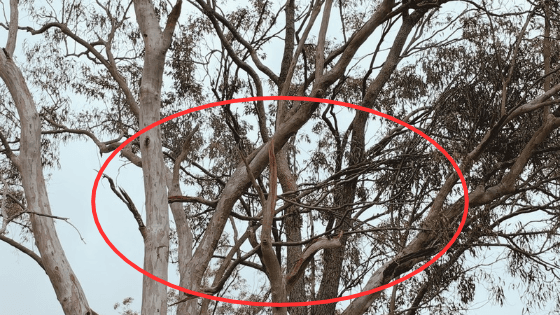
One of the more common hazards we see after severe storms is what arborists call a hanger.
A hanger is a branch that has broken away from the tree but remains suspended in the canopy, often caught or supported by surrounding branches.
These branches can be particularly dangerous because they may appear secure, even though they are no longer properly attached to the tree.
Wind, movement in the canopy, or the gradual deterioration of supporting branches can cause them to fall unexpectedly.
Our advice: After a storm, look up into the canopy of your trees, particularly those near your home, driveway, pathways and areas where people regularly spend time.
If you notice any broken or suspended branches, avoid standing or working underneath them and arrange for a qualified arborist to assess
and safely remove them.
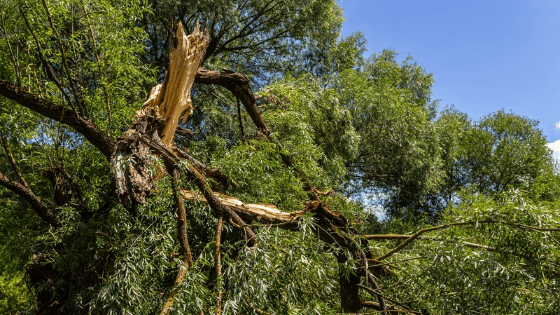
Another common form of storm damage is snapped limbs, where a branch breaks off, leaving a jagged or torn stub.
While the immediate danger of the falling branch may have passed, the remaining damage can affect the tree's long-term health and structure.
Why is this important?
Trees heal wounds through a process known as compartmentalisation.
When a branch snaps, it can leave exposed wood, torn bark, and damaged tissue. These wounds can provide opportunities for decay organisms to establish, particularly where the damage extends into the main stem or branch union.
Not every broken branch will lead to decay or structural failure, but poorly positioned wounds and large broken stubs can increase the likelihood of future problems.
This is why we often recommend correctly pruning damaged branches rather than leaving large, jagged stubs behind.
We regularly explain to our customers that how a branch is removed is just as important as why it's being removed.
Every snapped or pruned limb creates a wound.
Just beneath the outer bark is a thin layer of living tissue called the cambium. This layer produces new wood and inner bark as the tree grows.
When a branch is damaged, the tree responds by forming protective boundaries within its tissues to limit the spread of decay. Over time, new tissue known as woundwood may grow around the edges of the wound.
However, the tree's ability to respond effectively depends on several factors, including the wound's size and location, the species, its overall health, and how the branch was removed.
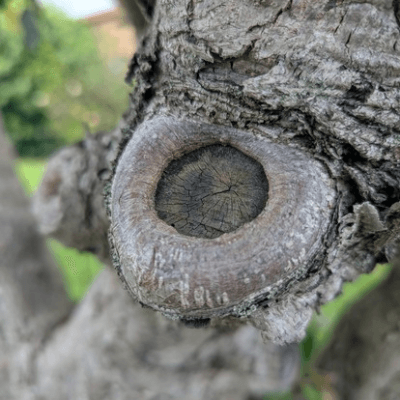
Pcitured: Woundwood - trees natural healing response to the correct cut
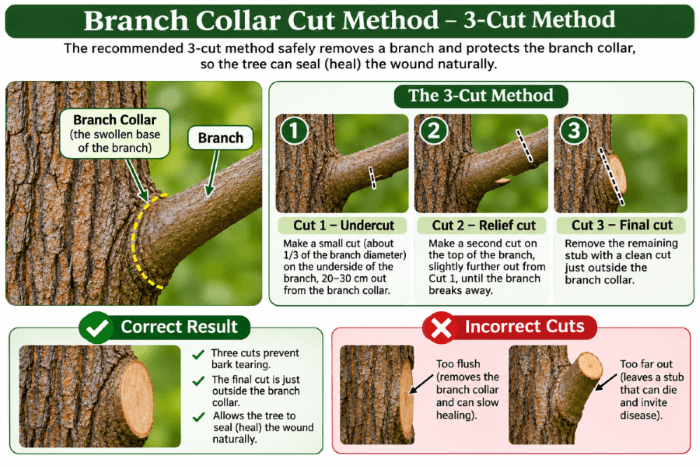
When arborists remove a branch, we generally aim to make the final cut just outside the branch collar.
The branch collar is the area where a branch joins the tree and contains protective tissues that help limit decay after pruning.
A correctly positioned pruning cut:
One common mistake is cutting a branch flush against the trunk. While this might look neat, it removes important protective tissue and creates a larger wound.
Leaving an excessively long stub isn't ideal either, as the remaining wood may die back and decay before the tree can effectively grow over the wound.
The aim is a clean, correctly positioned cut that preserves the branch collar, not a cut as close to the trunk as possible.
It's also worth remembering that woundwood doesn't guarantee a tree will be free from decay. Trees can often successfully compartmentalise wounds, but they cannot restore damaged wood to its original condition.
After a storm, it's understandable that homeowners want to get outside and start cleaning up.
For small, accessible branches, some basic pruning can be manageable with the right equipment and knowledge.
Here are a few important things to consider before you start:
Only tackle small branches you can reach safely from the ground. Avoid climbing trees, working from ladders with cutting equipment or attempting to remove branches that are suspended, split or under tension.
Storm-damaged branches can behave unpredictably. A branch that appears stable may suddenly move or release when cut.
If you're pruning a small branch yourself:
If the branch is large, located overhead, close to powerlines or showing signs of structural damage, it's best to leave it to an arborist.
Never attempt to remove a hanging branch from beneath it.
Storm damage isn't always limited to broken branches.
Strong winds can place significant forces on trees, particularly those with large canopies, existing structural defects or compromised root systems.
Following severe weather, keep an eye out for:
These signs don't automatically mean a tree needs to be removed, but they may indicate that a professional assessment is warranted.
In many cases, appropriate pruning and ongoing management can allow a storm-damaged tree to be safely retained, rather than removing it unnecessarily.
Trees are incredibly resilient, and many can recover from storm damage with the right care.The important thing is identifying any immediate hazards and making informed decisions about how damaged branches should be managed.
At Oasis Tree Management, we've been assisting homeowners throughout Logan, Brisbane Southside and the Scenic Rim with storm-damaged trees, fallen branches and make-safe works.
If you've noticed broken branches, hanging limbs or you're concerned about a tree on your property following the recent storms, we're
happy to help.
Contact Oasis Tree Management for advice or to arrange a free, no-obligation quote 0401 978 173.
www.oasistreemanagement.com.au